Diffuse Value Capture

1 Diffuse & Direct Value Capture
Alice and Bob both work 30 hours per week creating a similar digital good, and each captures some share of the value they create: money, reputation, opportunities.
| Alice | Bob | |
|---|---|---|
| Hours worked | 30 | 30 |
| Value created | 10 | 100 |
| Capture rate | 90% | 10% |
| Value captured | 9 | 10 |
Alice captures 90% of the value she creates; Bob captures only 10%. Yet Bob ends the week with one more unit of value than Alice, for the same hours of work.
Alice’s model is direct value capture: many-to-one, closed, permissioned. Bob’s is diffuse value capture: many-to-many, open, permissionless. The two exist on a spectrum, and extremes on either end are rarely workable.
The upside on the diffuse end has no ceiling. Produce 1,000 units of value and capture 1% and you keep 10; produce 1,000,000 and capture even 0.01% and you keep 100.
2 Authorship & Originality
“Print created national uniformity and government centralism, but also individualism and opposition to government as such.”
—Marshall McLuhan, The Gutenberg Galaxy, 1962.
Authorship and originality are downstream of the dominant medium of reproduction. When copying is cheap and decentralized, the bounded originating author becomes harder to defend.
For most of human history, cultural production was diffuse: stories built on stories, songs on songs. Before the printing press, works often circulated anonymously or under famous names borrowed for prestige; scribes copied freely because slow, manual duplication was the only real constraint. The press removed that constraint, and Western culture shifted increasingly toward direct value capture, culminating in the 20th-century broadcast era of Hollywood, television, music, and publishing. At the peak of that direct wave, the personal computer arrived and began swinging the pendulum back: not to a pre-industrial model, but to one built on decentralized global networks.
Cultural adaptation lags technological change. More than two centuries passed between the European printing press and the Statute of Anne, the first law to recognize authors, rather than printers, as rights-holders. The cycle has accelerated since, but the lag persists.
| Year | Tech/Event | Immediate Reaction | Lasting Legal Shift |
|---|---|---|---|
| 1040 | Bi Sheng (畢昇) invents movable-type printing in China | Modest adoption—woodblock printing remained more economical for a script of thousands of characters | Limited impact on Chinese legal frameworks for copying |
| 1450 | Gutenberg’s movable-type printing press | Explosion of vernacular Bibles, pamphlets; authorities panic over heresy. | None yet, copying suddenly cheap, rules nonexistent. |
| 1476 | Caxton sets up England’s first press | Crown issues ad-hoc printing patents, but enforcement is patchy. | Still no copyright—control via favors & guilds. |
| 1517 | Martin Luther’s Ninety-five Theses | Printed and distributed across Europe, sparks Reformation. | Demonstrates power of print to bypass traditional gatekeepers. |
| 1557 | Royal Charter for the Stationers’ Company | Guild monopoly lets Crown censor by licensing printers. | Corporate control substitutes for author rights. |
| 1662 | Licensing of the Press Act | Censorship tightens; printers need a license or face seizure. | Parliament grows wary of monopoly but has no alternative. |
| 1695 | Licensing of the Press Act Lapses | 15-year vacuum—anyone may print; pamphlet culture booms. | Chaos forces lawmakers in Parliament to rethink “who owns a text”? |
| 1710 | Statute of Anne | For the first time, authors, not printers, receive a 14-year exclusive right. | The birth of modern copyright—arrives more than 260 years after the printing press. |
| 1910 | Qing Copyright Code | Short-lived in its Qing form but modeled on European statutes | Carried forward by Republic-era acts (1915, 1928) |
| 1990 | PRC Copyright Law | Enacted September 1990, effective June 1991 | Modern copyright arrives in China—nearly three centuries after the Statute of Anne |
If the printing press took more than two centuries to produce modern copyright, the internet has had three decades. We are only at the dawn.
3 China Arrives From the Future
“The seal stamps on old Chinese paintings are fundamentally different from the signatures used in European paintings. Primarily they do not express authorship that might have authenticated the picture, thereby making it unassailable. Instead, most seal stamps come from connoisseurs or collectors who inscribe themselves into the picture not only through their seal but also through their commentaries. Here art is a communicative, interactive practice that constantly changes even the artwork’s appearance. Subsequent viewers of the picture take part in its creation.”
—Byung-Chul Han, Shanzhai 山寨, 2017.
What Han describes is not a stylistic preference but a different theory of art, one in which the work is finished by everyone who later touches it. China has a long literati tradition of individual authorship and signed work, but it also has a Daoist and Confucian strand that treats originality less as a singular act of creation than as an ongoing natural process. Skillful reference signals depth of knowledge, and originality lies more in subtle recombination than in radical novelty.

The clearest modern test of that older theory is happening in AI. In late 2023, DeepSeek open-sourced models that outperformed Meta’s Llama 2. A little over a year later, in January 2025, it released DeepSeek-R1, which matched OpenAI’s o1 on hard reasoning tasks, reportedly trained for a small fraction of what Western labs spend. And while the largest model needs server-class hardware, smaller distilled versions run on a consumer GPU.
Many Western incumbents lean toward more direct value capture: API call metering, closed weights, NDAs. Several leading Chinese labs have treated the model itself as advertising for downstream services, hardware, and prestige, keeping only a thin proprietary layer for coordination.
Critics often portray this looser stance on intellectual property as a drag on innovation. In an AI-driven century, it may prove prescient. The older remix tradition Han describes, rooted in naturalistic processes and continual transformation, may end up resembling the IP norms of the 21st century more closely than the romantic Western model: less a singular act of creation from a single source, more like evolution itself.
4 Neural Networks are Diffuse
Neural networks are diffuse by nature, and more direct value capture does not map well onto them.
Art, music, code, design, and other cultural artifacts, culled from the open web, are diffused across latent space. Once creativity is encoded as a multi-trillion-parameter fog, the notion that you can meter each droplet of inspiration the way you once metered a DVD sale becomes economically and technically incoherent.
A neural network does not store information like a database storing rows. Any given weight is meaningless in isolation; value emerges only from the statistical interaction of all weights acting in concert. Like pigments blended into paint, the original sources are no longer separable: you can’t point to a specific coordinate and say this vector belongs to that copyright holder.
There is little consensus on how the existing IP framework survives this, and proposals for serious reform, once considered fringe, are now discussed openly in mainstream tech circles.
The shift toward diffuse cultural production is a direct consequence of three converging trends:
-
The rise of decentralized networks over traditional media and finance.
-
Massively accelerated AI-driven content creation, built on a remix paradigm and inherently diffuse models.
-
The creator economy: platform payouts, micro-monetization, and attention markets that blur the line between leisure and labor.
None of this is driven by political will or personal preference. Stewart Brand named the tension: “Information wants to be free. Information also wants to be expensive… That tension will not go away.” It doesn’t go away, but market competition keeps resolving it in one direction. Prices fall toward the marginal cost of production, and for information that cost is near zero. Competition eventually breaches every barrier built to hold prices above that floor, and the ground rarely comes back. The motion is a ratchet.
This is why I see potential in diffuse value capture as a business model. A startup can work with the grain of the medium instead of against it, building a thin capture layer into an ecosystem that leaks more value than incumbents are comfortable leaking.
5 The Hacker Ethic
The precepts of this revolutionary Hacker Ethic were not so much debated and discussed as silently agreed upon. No manifestos were issued. No missionaries tried to gather converts. The computer did the converting.
—Steven Levy, Hackers, 1984.
Computers speak in copies, and the cost of duplication is effectively zero. When the medium itself is infinite replication, economic models based on overly direct value capture become difficult to maintain; the technology pulls toward abundance and sharing.
The architecture of computing encodes this hacker ethic at its core. McLuhan’s larger point applies: a medium’s form has second- and third-order effects on culture, far beyond its obvious uses. A medium of costless copying reshapes norms around authorship, labor, and property whether anyone wills it or not.
Artificial scarcity imposed by legal means in the digital realm is an awkward simulacrum of real-world scarcity. Forcing physical-world notions of property onto information systems creates endless friction and runs counter to the grain of the medium. This primal, often unspoken orientation at the heart of computing is what Richard Stallman later formalized as software freedom.
“We have already greatly reduced the amount of work that the whole society must do for its actual productivity, but only a little of this has translated itself into leisure for workers because much nonproductive activity is required to accompany productive activity. The main causes of this are bureaucracy and isometric struggles against competition. Free software will greatly reduce these drains in the area of software production. We must do this, in order for technical gains in productivity to translate into less work for us.”
—Richard Stallman, The GNU Manifesto, 1985.
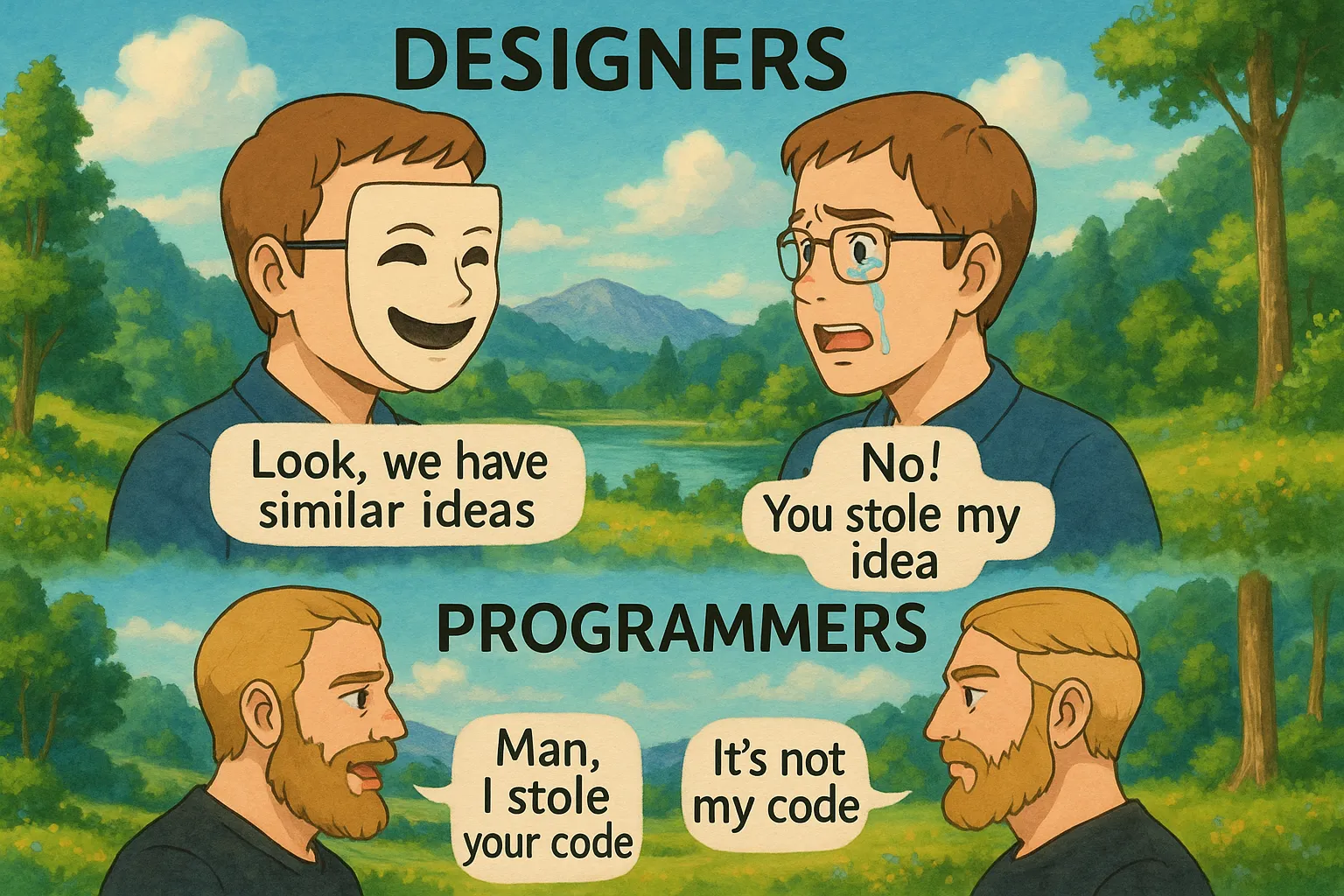
Free software, and the open-source movement that grew from it, has been at the core of computing culture ever since. As a result, programming culture has adapted to the shift toward diffuse value capture more readily than most other industries. In contrast, neighboring professions have struggled to move beyond the 20th-century mindset of more direct value capture, along with its emphasis on authorship and originality.
Despite its massive success, free and open-source software culture still struggles to develop effective systems for value capture and coordination. In many domains, it remains a niche: hobby projects, unpaid or underpaid labor, resume padding, or a supporting role in commoditize-your-complement strategies. The ecosystem continues to grapple with how to natively and diffusely capture value and coordinate production on its own terms.
Corporate patronage has been a primary driver of open-source development, and the ecosystem owes much of its scale to it. But the more direct capture systems large organizations run on do not always align with the diffuse nature of open source. Metrics-driven incentives can pull contributors toward what is measurable rather than what is valuable, and can quietly reward gatekeeping knowledge over sharing it. The result is friction against the open, collaborative ethos that makes the ecosystem work.
More diffuse strategies align incentives with openness and ecosystem growth: the more you share and the more you help the project around you grow, the more value you ultimately capture. Some gatekeeping still protects community culture, but the information asymmetry and cronyism that more direct systems produce are less financially rewarded. The hacker ethic becomes aligned with financial incentives at the highest levels of the market, where it previously stood in tension with them.
6 Post-Authorship
Over-reliance on direct value capture breeds an obsession with authorship and originality, and the obsession has become a weight on creativity, collaboration, and the incentive to produce. The path to success becomes isolating, owning, and defending infinitely copyable ideas: at odds with how culture and technology actually evolve, and actively suppressing the social, memetic nature of cultural production.
Design social media shows the pattern at work. Scroll long enough and you’ll see an endless parade of designers complaining that someone stole their work, recently over things as trivial and obviously un-ownable as color gradients. Meanwhile the quality of design in the everyday world degrades: the pressures of more direct value capture push designers toward performing as expressive auteurs rather than building durable visual systems. What our environment gets in return is expressive slop where functional, authorless late-modernism used to be.
Case in point, from late 2023: the “Satie graphic” from this tweet turned out on inspection to be little more than the font Ogg Regular with one character swapped to italic and a bit of tracking.
The Satie graphic is just the font Ogg Regular with the i changed to Ogg Regular Italic, plus a little bit of tracking…https://t.co/XtOXnRN6jE https://t.co/i59g2tbP5P
— Eli Heuer (@eliheuer) November 30, 2023
Many programmers and designers are financially incentivized to work in proprietary models on large projects they have little authorship over. Can open, permissionless projects recreate those incentives natively?
7 Post-Authorship Peer Production
“There is no reason to believe that bureaucrats and politicians, no matter how well meaning, are better at solving problems than the people on the spot, who have the strongest incentive to get the solution right.”
—Elinor Ostrom
TikTok is a useful middle-of-the-spectrum example. ByteDance owns the platform and a proprietary algorithm decides which videos propagate, but the creation layer is diffuse: a format emerges, thousands of creators remix it, the best versions spread, the rest fade. The same coordination shape shows up in GitHub, Hugging Face, and Linux, at points further toward the diffuse end: many contributors, flatter hierarchies, and output that stays available for anyone to use, remix, and extend. Call it post-authorship peer production.
Post-authorship removes many of the barriers to collaboration that have held back peer production, especially in cultural areas like art and design. When contributors stop worrying about who owns what idea, energy shifts from defending territory to building together, unlocking long-tail innovation.
Once the first copy of a program, video, or AI model exists, duplicating it costs almost nothing. Competitive pressures, piracy, and open-source alternatives push prices toward the marginal cost of production, which for digital goods is near zero. In this environment, diffuse value capture often outperforms direct approaches like paywalls, DRM, and legally enforced artificial scarcity. Incentives aren’t abolished but rewired.
The printing press took more than two centuries to produce modern copyright. Networked software and AI may rework it in decades rather than centuries. The rails for diffuse value capture are already being laid; cultural norms just need time to catch up.
Colophon
This post is typeset in Virtua Grotesk, a free and open-source font designed by Eli Heuer, the essay’s author. It is built on the authorless memetic commons of the International Typographic Style and the work of many other designers, both known and unknown.